Research
My research develops novel statistical methodology with applications in health sciences
Causal Inference with Complex Treatments
Keywords: Modified treatment policies, Continuous/vector-valued/functional treatments, Weighted energy distance, Ventilator-induced lung injury, Wearable-device physical activity.
Many real-world interventions for causal inference are inherently multi-dimensional or continuous — ventilator pressure–time curves, daily physical activity trajectories, multi-component drug regimens, and dose–duration combinations. My research develops a unified framework of modified treatment policies for such settings, covering continuous-valued, vector-valued, and functional treatments. Within this framework I target data applications where the treatment cannot be reduced to a simple binary contrast. In critical care, I use the multivariate modified treatment policy (MVTP) to estimate the causal effect of mechanical ventilation on ventilator-induced lung injury, treating the joint settings of tidal volume, positive end-expiratory pressure, and driving pressure as a vector-valued exposure. In wearable-sensor studies, I use the modified functional treatment policy (MFTP) to estimate causal effects of entire daily physical activity trajectories, where each subject’s treatment is a curve rather than a single summary statistic.
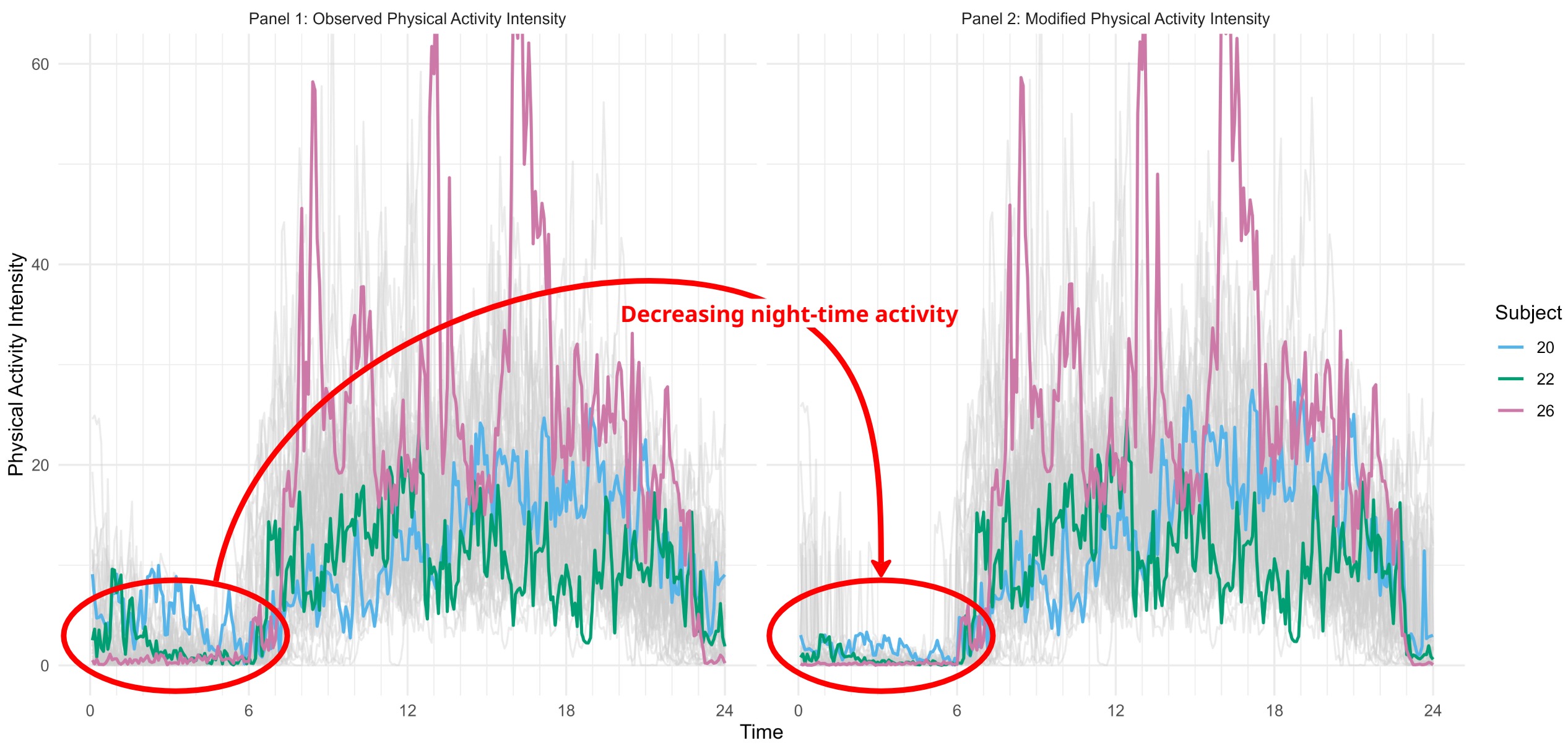
- Ziren Jiang, Jared Huling. Modified treatment policy effect estimation with weighted energy distance. Annals of Applied Statistics 19, no. 4 (2025): 2555–2577. [DOI] [PDF] Recipient of the ENAR Distinguished Student Paper Award (2024) and the Health Policy Statistics Section (HPSS) Student Paper Award, JSM (2024).
- Ziren Jiang, Philip S Crooke, John J Marini, and Jared D Huling. Exploring the effects of mechanical ventilator settings with modified vector-valued treatment policies. Journal of the Royal Statistical Society, Series A (Statistics in Society), to appear. [DOI] [arXiv] [PDF]
- Ziren Jiang, Erjia Cui, and Jared D. Huling. Estimating causal effects of functional treatments with modified functional treatment policies. arXiv preprint arXiv:2602.09145 (2026). Under review. [arXiv] [PDF]
High-Dimensional and Functional Data Analysis
Keywords: Bayesian multiple imputation, Tensor (multiway) data, Functional data, Bayesian functional regression, Stan.
Modern biomedical data are often high-dimensional (e.g., spanning multiple cell types, tissues, or body regions) or measured over a continuum (e.g., continuous activity curves from wearable devices). I develop Bayesian methods for analyzing such data, including BAMITA, a Bayesian multiple-imputation method for tensor (multiway) data; BAMIFun, a Bayesian multiple-imputation method for functional data; and a Stan-based tutorial and software package (refundBayes) that makes Bayesian functional regression — with scalar, functional, or survival outcomes and flexible functional predictors — broadly accessible to applied researchers.
- Ziren Jiang, Gen Li, Eric F Lock. BAMITA: Bayesian Multiple Imputation for Tensor Arrays. Biostatistics 26.1 (2025): kxae047. [DOI] [PDF]
- Ziren Jiang, Ciprian Crainiceanu, Erjia Cui. Tutorial on Bayesian Functional Regression Using Stan. Statistics in Medicine 44, no. 20–22 (2025): e70265. [DOI] [PDF] [R package: refundBayes]
- Ziren Jiang, Lei Xuan, Eric F. Lock, and Erjia Cui. BAMIFun: Bayesian Multiple Imputation for Functional Data. Biometrics, to appear. [arXiv]
Evidence Synthesis and Causal Generalizability
Keywords: Indirect treatment comparison, Matching-adjusted indirect comparison (MAIC), Hazard ratios, Effect size transitivity, Meta-analysis, Reference intervals.
Regulatory and health-technology decisions almost never rest on a single trial; they must synthesize heterogeneous evidence — different populations, different comparators, aggregate vs. individual-patient data. My work develops and evaluates methods that transport causal effects across study populations in this setting. I have contributed a comprehensive review of matching-adjusted indirect comparison (MAIC) and a companion R Shiny tool, a critical assessment of MAIC under violations of common assumptions, and methodology for combining hazard ratios in indirect treatment comparisons. I also develop meta-analytic methods for reference-interval estimation from individual-patient data (and an accompanying R Shiny app, RIMeta).
- Ziren Jiang, Jialing Liu, Weili He, Joseph C. Cappelleri, Satrajit Roychoudhury, Yong Chen, Haitao Chu. The Hazards of Using Hazard Ratios from Proportional Hazard Models in Indirect Treatment Comparisons. Research Synthesis Methods 17, no. 3 (2026): 483–497. [DOI] [PDF]
- Ziren Jiang, Jialing Liu, Demissie Alemayehu, Joseph C. Cappelleri, Devin Abrahami, Yong Chen, Haitao Chu. A critical assessment of matching-adjusted indirect comparisons in relation to target populations. Research Synthesis Methods 16, no. 3 (2025): 569–574. [DOI] [PDF]
- Ziren Jiang, Joseph C. Cappelleri, Margaret Gamalo, Yong Chen, Neal Thomas, Haitao Chu. A comprehensive review and shiny application on the matching-adjusted indirect comparison. Research Synthesis Methods 15, no. 4 (2024): 671–686. [DOI] [PDF] [Shiny app: Shiny-MAIC] Recipient of the Student Poster Recognition Award, ASA Biopharmaceutical Section Regulatory-Industry Statistics Workshop (2024).
- Ziren Jiang, Haitao Chu, Zhen Wang, M. Hassan Murad, and Lianne K. Siegel. Estimating reference intervals from an IPD meta-analysis using quantile regression. BMC Medical Research Methodology 24, no. 1 (2024): 251. [DOI] [PDF]
- Ziren Jiang, Wenhao Cao, Haitao Chu, Fateh Bazerbachi, and Lianne Siegel. RIMeta: An R shiny tool for estimating the reference interval from a meta-analysis. Research Synthesis Methods 14, no. 3 (2023): 468–478. [DOI] [PDF] [Shiny app: RIMeta]
- Darrick K. Li, Samir Haffar, Ziren Jiang, Lianne Siegel, M. Hassan Murad, Haitao Chu, Fateh Bazerbachi. Normal Reference Range of Shear Wave Liver Elastography in Apparently Healthy Adults: A Systematic Review and Meta-Analysis. Gastroenterology 164.6 (2023): S-404–S-405. [DOI]
- Ziren Jiang, Joseph C. Cappelleri, Xiaoyu Tang, Monica Ines, Christine Baker, Haitao Chu. The Role of Effect Size Transitivity in Indirect Treatment Comparisons. Under review.
Prediction and Risk Modeling
Keywords: Hospital readmission, Electronic health records, Hierarchical regularization, Semi-competing risks, Joint models, Stagewise variable selection.
Patient populations in health systems are highly heterogeneous across primary diagnoses, so risk-prediction models must be tailored to subgroups yet remain interpretable. I develop hierNest, a hierarchical prediction framework that combines hierarchical nested re-parameterization with structured regularization: it exploits the nesting of primary diagnoses within major diagnostic categories to borrow information across related patient subgroups while preserving interpretability at each level, and I apply it to predicting hospital readmission from a large electronic health record dataset of Medicare patients. I also contribute to a stagewise selection framework for joint models for semi-competing risk prediction.
- Ziren Jiang, Lingfeng Huo, Jue Hou, Mary Vaughan-Sarrazin, Maureen A. Smith, and Jared D Huling. Heterogeneous readmission prediction with hierarchical effect decomposition and regularization. arXiv preprint arXiv:2603.19569 (2026). Under review. [arXiv] [PDF] [R package: hierNest]
- Lingfeng Huo, Jue Hou, Ziren Jiang, Mary Vaughan-Sarrazin, Maureen A. Smith, Jared D. Huling. A stagewise selection framework for joint models for semi-competing risk prediction. Under major revision at Journal of Computational and Graphical Statistics.
Clinical Trial Design and Master Protocols
Keywords: Platform trials, Nonconcurrent controls, Basket trials, External control arms, Information borrowing, Blinded safety analysis.
Modern trials — platform trials evaluating many arms over time, basket trials studying one therapy across multiple indications — can sharply reduce cost and time to evidence, but introduce non-trivial statistical challenges: treatment arms enter and leave at different calendar times, the shared control accrues across periods, and indications differ in prognosis. I work on statistical strategies that leverage this structure responsibly, including methods for borrowing from nonconcurrent controls while preserving Type I error, adaptive borrowing from concurrent controls across periods, and the use of external control arms (real-world or historical) to augment small basket-trial indications. The goal is efficiency gains that a regulator can audit.
- Ziren Jiang, Cindy Lu, Jialing Liu, Satrajit Roychoudhury, Daniel Meyer, Bo Huang, and Haitao Chu. Nonconcurrent Controls in Platform Trials: Can We Borrow Their Concurrent Observation Data? Statistics in Biopharmaceutical Research 17, no. 1 (2025): 17–26. [DOI] [PDF]
- Jialing Liu, Chengxing Lu, Ziren Jiang, Demissie Alemayehu, Lei Nie, and Haitao Chu. Borrowing Concurrent Information from Non-Concurrent Control to Enhance Statistical Efficiency in Platform Trials. Current Oncology 30, no. 4 (2023): 3964–3973. [DOI] [PDF]
- Ziren Jiang, Haitao Chu, Georgie Weston, Lei Nie, Cindy Lu. Using External Control Arms in Basket Trials: Strategies for Borrowing Across Baskets. Under review.
- Enze Wu, Haitao Chu, Philip He, Lian Lin, Joseph Ibrahim, Bo Huang, Ziren Jiang. Integrative Safety Analysis of Blinded and Unblinded Data Using a Bayesian Hierarchical Model. Under major revision at Research Synthesis Methods.